Hey class. Professor Gray Balls here, kicking off today's Music Video Mystery School lesson featuring "Smells Like Teen Spirit" with talking about school. Specifically the kind of school I attended as a teen, that of the public variety.
During this age of teen, I had little spirit for attending public school. My parents would tell me they had to put me in school otherwise government could put them in jail. An ironic punishment, since jail is what being in public school felt like to me. There’d be a many’a sunny days I’d be sitting in public school/jail thinking, “How do I bust out of this joint?”
It makes sense public school and jail feel similar, since they’re both run by the same institution—government. In fact, government runs most of the least enjoyable places I’ve ever been. Courthouses. The department of motor vehicles. City Hall. The government-controlled parts of airports that demand we stand in lines for shoe and dignity removal.
My parents, I assume as well as most people, didn’t want to go to jail just as I didn’t want to go to public school/jail, perhaps because of the similarities. Each require a significant portion of time. Each forces the performance of tasks we didn’t choose, alongside people we didn’t choose, according to rules we didn't design. Each demanding we demonstrate that we’re learning what the institutions want us to learn. Each operates through rigid hierarchies that are sometimes violent. Each serves food of questionable nutritional value. And finally, each is funded through what we politely call taxation.
TAX / Armed Robbery with Threat of Kidnapping
Strip away the euphemisms and taxation is a system where non-payment results in tax-paid-for employees wielding tax-paid-for weapons to confiscate our property, or put us in tax-paid-for jails. All this tax collecting requires a tremendous amount of taxes, devoting massive resources to collect these massive resources.
In viewing taxes in this way, a more proper term could be “armed robbery with threat of kidnapping”—albeit not as catchy of a title. In this matter, branding matters. Commonly used phrases like “Nothing is certain except for death and taxes” do important public relations work. Whereas “Nothing is certain except for death and armed robbery with threat of kidnapping” would probably inspire revolt or despair—neither of which are ideal for long-term revenue collection.
I use this alternate taxation term to be humorous but also to make visible what language normally hides—the psychological repercussions of compliance through force.
If this system were isolated, maybe it would be easier to ignore. But it’s global. Most societies are structured this way. Which means much of the modern world is built atop normalized coercion—robbery, imprisonment, war. To add an additional irony, all of these are acts governments deem illegal for its citizenry. Causing reason to wonder how living inside such a structure shapes the psychology of those born into it, perhaps even subconsciously inspiring us to perform these illegal acts more so—just as children, for better or worse, mimic mom and dad.
This seems like an important subject for psychological study. Yet in researching if anyone is researching this, I’ve found surprisingly little research. So, let’s do our own little exploration by pondering the deeper implications of the various tax types’ effect on society. And yes, this does connect with the “Smells Like Teen Spirit” music video—hang tight, we’re getting there soon.
The sales tax: Businesses pay government to not stop them from doing business—thus putting government in the same business model as the mafia, offering businesses “protection” (which means protection from the mafia/government itself) if it gets its “taste” of the profits.

The income tax: Robs us of not only money but also time—which, as the old saying goes, is the same thing. Therefore, our most precious, ever-fleeting commodity of time in this existence is taxed.
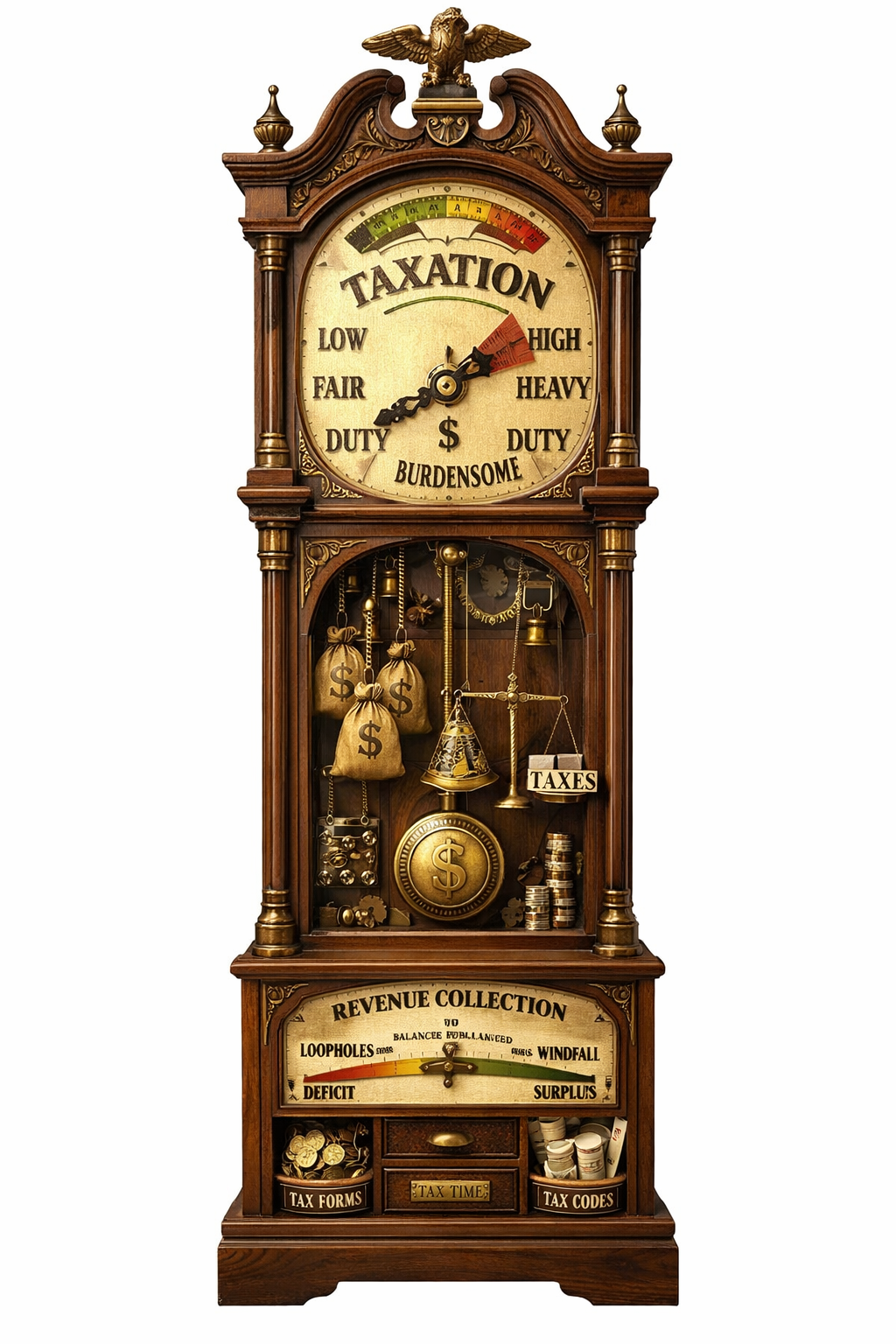
The travel tax: Adds an additional forced payment to the ways we move about in this world. There's many government implimented additional costs with driving a car. There's fees to get a driver's licence, license plate, registration, manditory insurance, and all the fines that can come along with not playing by not correctly following government's many made up regulations. These could all be considered unofficial portions of this tax, not to mention the actual tax on our vehicles which we'll touch on in three paragraphs into the future.
The most commonly refered to travel tax is the additional cost of participating in the modern marvel of traveling through the air. This supposedly goes toward governments additional presence at air ports to make air travel “safe.” Supposing the airlines themselves wouldn’t do this on their own accord for the simple reason that getting people to their destination alive is good for business.

The passport system: Could be considered an addition to this travel tax. Obtaining this pass to port requires citizens to pay to jump through bureaucratic hoops to get government’s permission to come and go—thus giving power to an entity that’s only as real as we believe it to be, to give us permission to cross borders that are only as real as we believe them to be. We can extend this thought to our last but not least highlighted tax type.
The property tax: Taxes the land, homes, and automobiles that we supposedly “own” because we’ve paid for them and have paid a tax on them initially—but the taxing doesn’t stop there. Payment requirements reoccur yearly for as long as you “own” it—making it not a tax at all, and making “our” property not ours at all. The more proper term for this payment would be rent, which in turn turns all land and car owners into renters—and thus turns government into the ultimate landlord of all lands and vehicles.
The implications of this run deeper since all the land is divided into places we're allowed and not allowed to be. We’re not allowed to roam freely exploring this earth we’ve all been birthed onto. A privilege our ancestors enjoyed that may be one of the great meanings of existing in this existence—but now it comes with a price tag. We pay to rent a place to even have the opportunity to freely interact with the environment. This can only occur in a restricted area government lets us pretend to own. Even then we aren't totally free to do with that environment what we please. There's plants government has deemed illegal to grow and building codes we're expected to follow, otherwise government may use our property tax monies to pay for the force necessary to take our property away.
And if we don't pay the government to let us pretend to own a land, there’s nary an opportunity to even do the government approved interacting with the land. This is because most government-approved common areas don’t have nature to interact with because it’s been scabbed over with cement and buildings. Additionally, the common areas reserved to be nature—typically called parks—many come with a price-tag entry fee, close at certain times, or require extra costs to sleep there. They typically restrict land interaction like harvesting or planting. Many discourage exploring outside of marked trails. These fees and restrictions turn our common nature areas into something more like theme parks and hotels.
GOD / Government
Since interaction with the land is literally where all human creation comes from, one could consider the land to be a God of sorts—and since government is in the position of owning all the land, it could be considered to be a God of sorts, albeit of the made-up-by-humans, false variety.
The similarities between false God/Government and the aspects many typically associate with God are uncanny.
God could be considered all the land. Government claims ownership of all the land. People pray to God to solve their problems. People vote people into government to solve their problems. People pay a tithe to an organized religion. People pay a tax to the organized religion of government. Organized religion God has commandments. Government has laws. Organized religion has clergy. Government has politicians. Organized religion has temples. Government has capitol buildings. Organized religion has sacred texts. Government has constitutions. Organized religion requires pilgrimage. Government requires standing in lines. Organized religion requires confession. Government requires document signatures. Organized religion wants offerings. Governments wants fees. God gives blessings. Government gives tax breaks. God exists forever based on belief. Government exists forever based on belief.
Since organized religions and corporations are the only entities the government lets actually own property tax-free, and since individuals also turn to organized religions and corporations to solve their problems in a similar false God fashion, all three could be considered an unholy trinity of sorts.
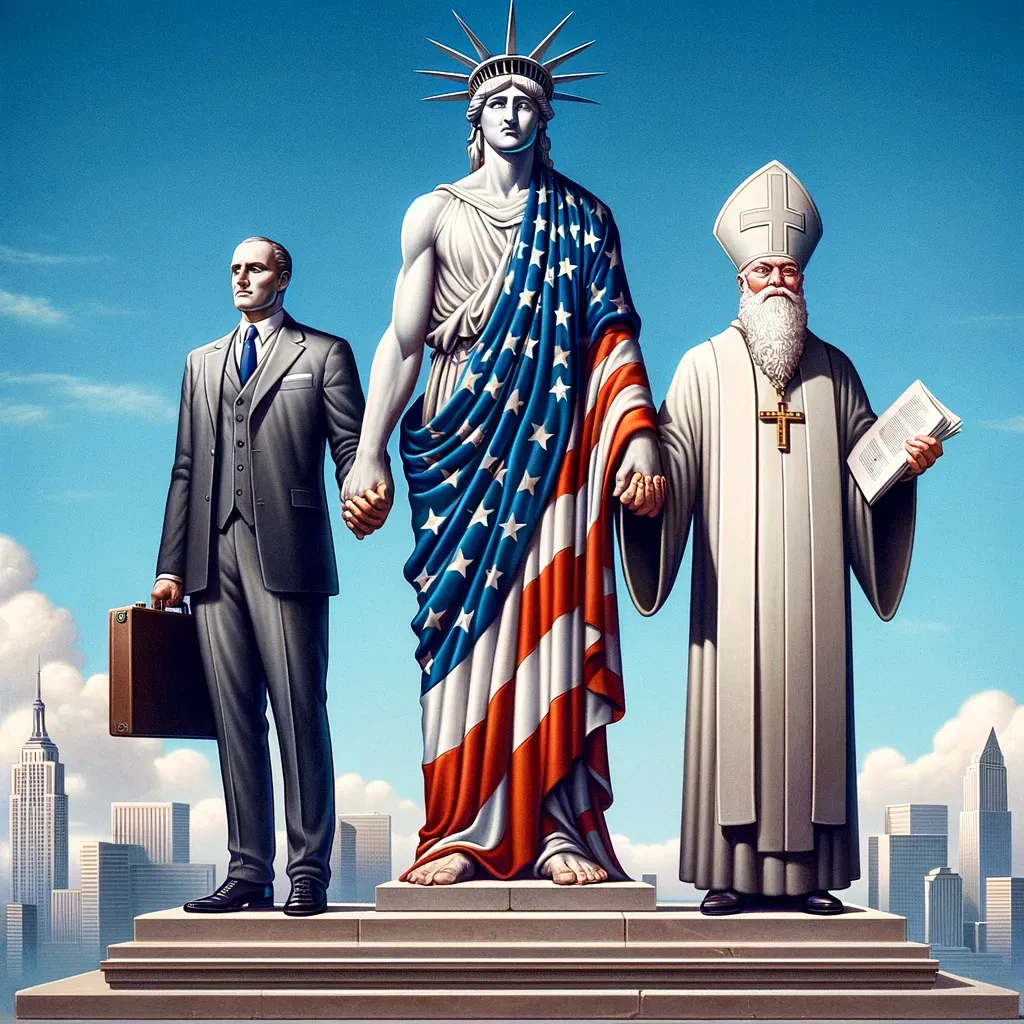
Meanwhile, this serves as much distraction to what could be considered an undeniably true holy trinity of Gods—the individual, the existence outside of the individual, and the interaction between the two. This is how we all create, how all our existence gets shaped, and—for better or worse—how the false God trinity of unholiness got created in the first place.
These types of ideas are not typically taught in public school/jail, perhaps because it could lead people to stop believing in the false Gods—and they’d cease to be. I would imagine this is one of the reasons why government got into the schooling business in the first place: to encourage young minds to support maintaining its power structure. The clue to this could be found in the etymology of the word "government".
govern = to steer, direct, or control
ment = the condition or result of, or means or instrument of getting said result.
Also "ment" can be related to the latin word mens which means "of the mind".
That isn't the context for this suffix use, but is worth noting.
ENTERTAINMENT / Enslavement
One of the ways governments have long since learned to instrument control of its citizenry is through what the Roman Empire would call “bread and circuses,” which basically means keeping people fed and entertained.
Modern-day United States government uses this tactic. In the “bread” category, forced-payment tax dollars go toward subsidized crops like corn, wheat, soybeans, and sugar. Not the healthiest foods—some would even call them not healthy foods, especially the way they're most times subsidized to grow in a monocrop, chemically enhanced process—but they can fill you up so you feel like you’re fed.
In the “circus” category, one could consider the very way government functions—the political process—to be such an entertainment, especially if that “one” is musician Frank Zappa with his satirically poignant quote…
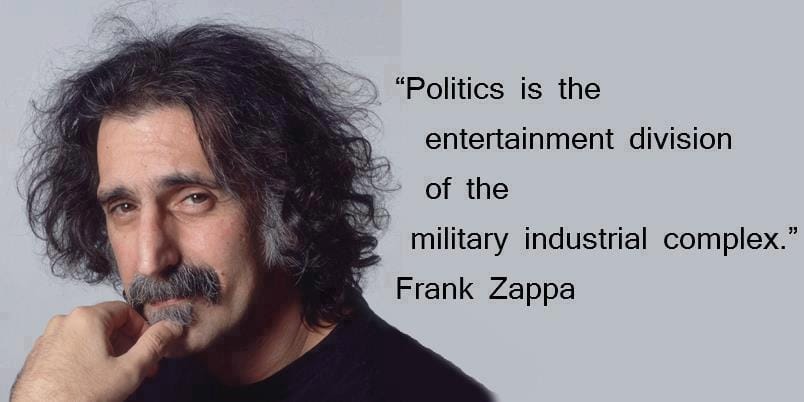
The “military industrial complex” part of this quote refers to a term former President Dwight Eisenhower coined as he was becoming former president.
Eisenhower's Military Industrial Complex Speech Paraphrased: "You're Fucked".
In his farewell address to America, he tells America who was gonna be the next president—and was not going to be who gets elected to be the next president. Unless drastic action were to take place, from then on all presidents would be the ever-growing complexity of military and industry and its unquenchable desire to expand. The truth in this is perhaps evidenced by the next president, John F. Kennedy, being mysteriously murdered in public—and then every president after refraining from even uttering the phrase. So it seems the military industrial complex instrumented control over those who are supposed to instrument control over government.
But instrumenting control over government’s highest leadership position isn’t a long-term solution for continued complex expansion. It’s best to start young. No better place to do that than public school/jail—and of course to instrument control properly, it’s gonna need that bread and circus.
The bread, a.k.a. the food, in public school/jail comes in the form of corporation-enhanced lunch programs and processed-food snack/soft-drink vending machines. The circus, a.k.a. the entertainment, comes in the form of a many a number of after-school/jail extracurricular activities—most notable at the high school/jail I attended was that of football.
Football could be considered the military industrial complex of extracurricular school/jail activities. It consumes the resources of other extracurricular activities like marching band and cheerleading, as well as inspiring non-school/jail-associated community members to pay to see the play—money the boys playing the game do not receive.
Ironic this so-called institution of learning supports this known brain-damage-causing game. Extra ironic that it supports it further by pausing the regularly scheduled school/jail hours of learning to require all students and staff to attend an event known as a pep rally.
PEP RALLY / Ritualized Obedience
A pep rally’s purpose is to pep people up for the football game that will occur later that evening. The marching band plays the songs they’d play later at the game. The cheerleaders do the cheerleadings they’d do later at the game. The football players get a hyped-up introduction like they’ll receive later at the game. All the spectators sit or stand, clap or make some sort of whooping-type sound like they’ll do later at the game. Everyone plays their role like we’re rehearsing for a play. It feels like a rehearsal because it is a rehearsal. It’s a warm-up for a ritual to cheer for hierarchies we don’t benefit from. We’re receiving a lesson in collective obedience disguised as school spirit.
For many of us, the ritual extends to not just later at the game but for many games for the rest of our lives—some devoting many hours, perhaps whole days to playing the role of putting care into the outcomes of games being played by people we don’t know, in towns we’ve never lived in. This behavior has never made much sense to me, since I find it hard to care about a game that I’m not playing. I hear people state reasons for this involving team pride. Community. Athletic excellence. Betting. Entertainment.
No one ever says to distract from feeling trapped in a society run on violence.
Which is ironic, because football is a violent game—heavily sponsored by a violent industrial complex with military recruitment as an advertiser, broadcast on networks tied to weapons manufacturing, and partially funded by tax dollars that go toward staging patriotic displays. Whatever else it is, it’s undeniably circus.
My personal role in the pep rally, and later at the game, was of the marching-band bass-drum-player variety. I volunteered for this role because of my love for music and creativity, caring little for the pep in sports ball it may inspire. But unfortunately, this marching-band role—with its marching-band songs and uncomfortable uniform wearing—didn’t provide the most personal creativity fulfillment. Especially when compared to what I was witnessing when released from school/jail, when I’d indulge in distraction from the horrid post-school/jail appendage of homework by turning on television to witness my favorite art form of music videos.
That’s where, in the fall of 1991, I saw the pep rally of my dreams, and yep, we're finally talking about the music video.
Nirvana - "Smells Like Teen Spirit"
Dir: Samuel Bayer
Here we are now. Entertain us.
When we break down the word “entertainment” we get…
enter = inside or to be among
tain = to grasp or posses
ment = the condition or result of, or means or instrument of getting said result.
Basically, an instrument of possessing from the inside. This is why the instrument of control of government puts much resource into possessing individuals with entertainments.
In "Smells Like Teen Spirit" Nirvana's singer/songwriter, Kurt Cobain, sarcastically sings, “Here we are now. Entertain us,” while we’re ironically witnessing this music video entertaining us. This entertainment did in fact posses me in way that I wouldn't fully realize till decades later as a middle aged adult. It's initial possession came from it depicting a pep rally similar to my school/jail experience, minus the aspects I didn't enjoy. There were no principals policing movement. The band featured instruments which were not involved in our school/jail marching band (except for the one I played, bass drum, yesss!) They were playing a loud, aggressive, yet somehow melodic song that inspires the student body to move their student bodies freely. Even the janitor was having a good time.
This was my introduction to Nirvana—the band—and nirvana, the concept. Often associated with a Buddhist term meaning a state of harmony. Supposedly, Nirvana chose the name Nirvana as a means to stand out from all the punk bands not naming themselves after Buddhist terms. This mosh-pit-inspiring, guitar-feedback-loving band labeling itself as a word for harmony may seem ironic at first, but nirvana is exactly what I felt in witnessing Nirvana.

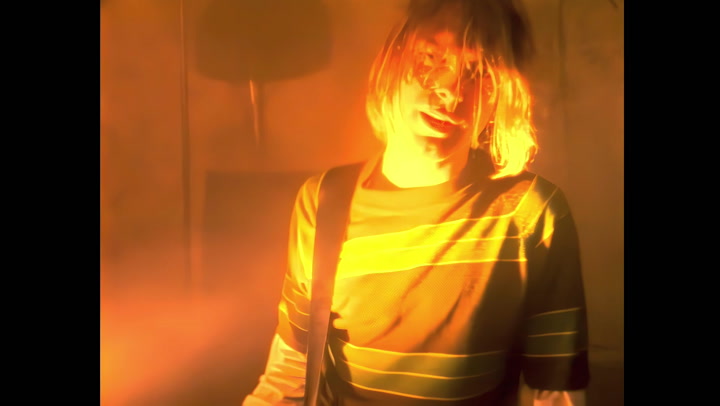
Nirvana is free.
MOSH PIT / Life
Even what may seem like one of the most chaotic parts of the video—the mosh pit—is inherently harmonious. This can be noted in the criteria for a good mosh pit. All participants are there voluntarily, moving how their move inspired. We may get knocked down, but chances are we’ll get helped back up. It’s in the group’s best interest to help each other—otherwise the mosh pit ends. It’s hard to mosh proper when there’s a bunch of hurt people laying on the ground.
The mosh pit isn’t a utopia. It’s messy, physical, sometimes painful. But it functions without central authority—being an example of another term associated with Buddhism: spontaneous order—harmony within the mind, as well as society at large, without need of force or control.
This spontaneous-order term is also frequently associated with anarchic philosophy, supposing that without a central authority of governance, humans would organically find ways to cooperatively self-govern. A few other principles of anarchy are freedom of association, self-management, mutual aid, radical equality, and anti-authoritarianism—all of which would be unofficial principles of the mosh pit, and the antithesis to the armed robbery with threat of kidnapping of the military-industrial-complex-controlled tax system that taught me, as well as many others, that anarchy doesn't work, cause it equals chaotic violence. But what if actually anarchy is our natural state of being, and the only reason it wouldn't "work" is because there's an entity implimenting control, throwing off the balance.
The mosh pit seems dangerous—but it self corrects. Public school/jail takes many measures to seem "safe"—but people get hurt mentally, psychologically, physically, and far too often mortally. Its highly possible that chosen chaos is safer than imposed order, and that we only think otherwise cause the institutions and their imposed rituals are training us to do so.
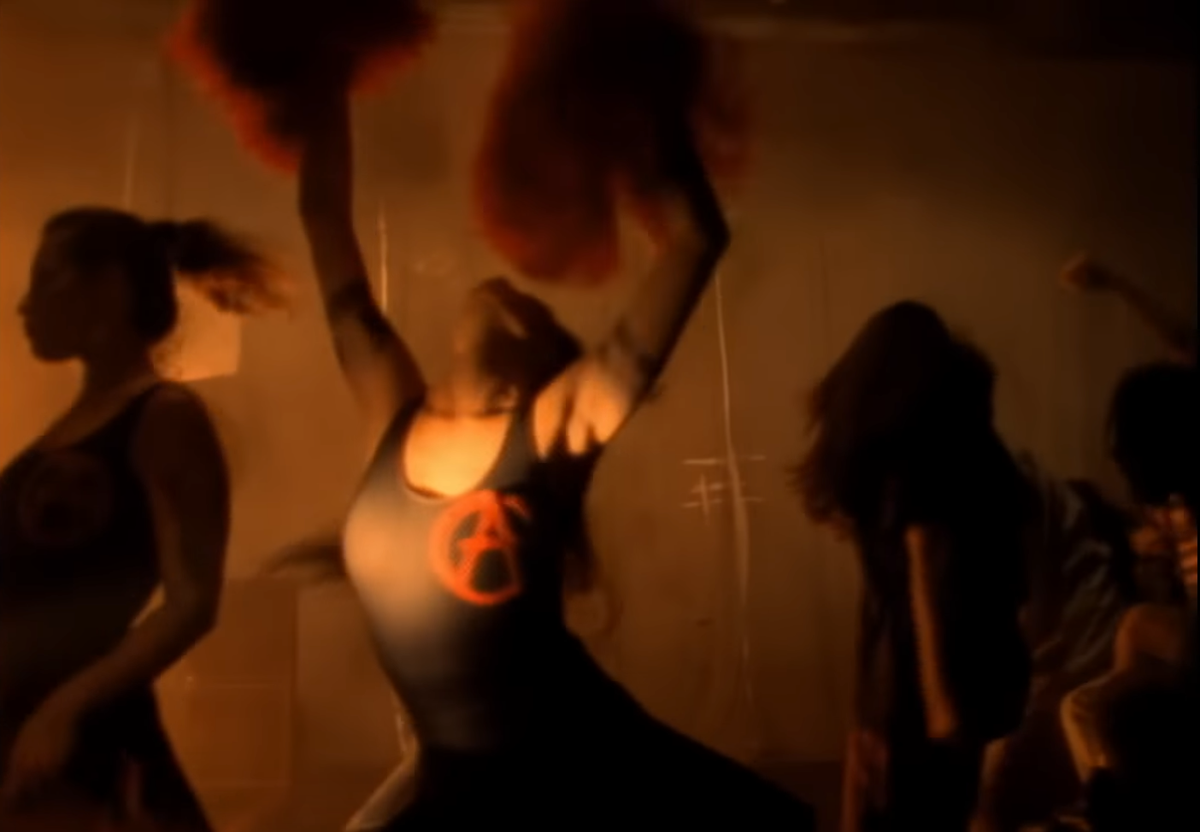
I think this is the message being subtly whispered in this loud rock music video. The crowd stops being a crowd and becomes part of the band’s space, eliminating separation. The janitor dances with joy with his mop, his tool for bettering the environment. The cheerleaders don't stick to choreography, they'll individually ecstatically sway their pom poms to the heavens when they feel, just as everyone else moves how they feel. There’s no hierarchy. No rehearsal. No ritualized obedience.
The symbol on the cheerleaders’ uniforms isn’t subtle.
This is a pep rally for anarchy.
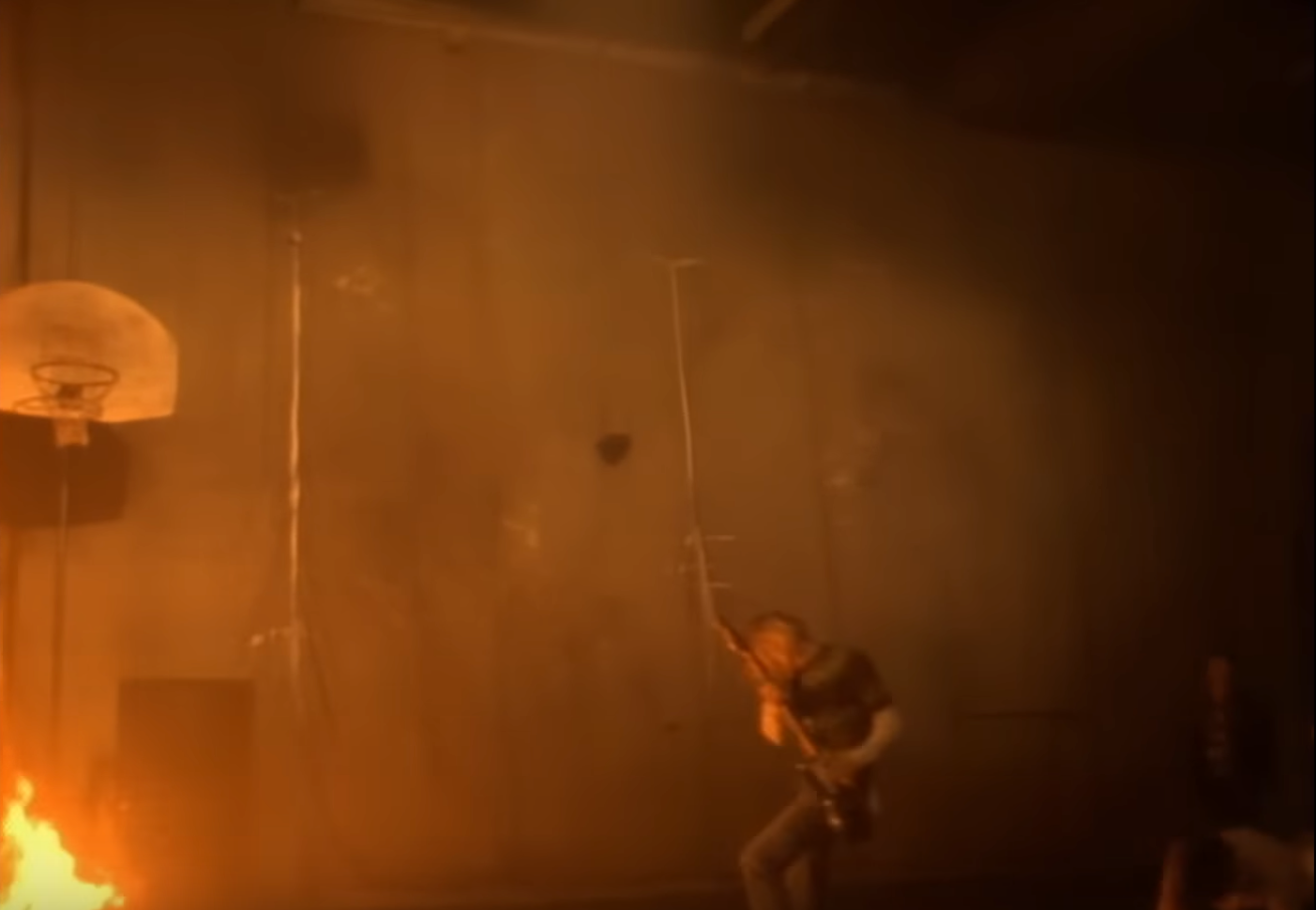
ANARCHY / School
It is fun to imagine what an anarchy-based school could actually look like in real life—visualizing a curriculum free from coercion. Classes organized not around obedience, but how to live for free in the supposed land of the free. A common thread that pops in my brain while brainstorming this is care.
Care for the self: meditation, movement, dance, music, art, nutrition, rest, play, sunlight, touching earth, touching trees, touching each other in consent.
Care for each other: consent, communication, conflict resolution, cooperative creation, shared meals, first aid, leadership without domination, cooperative activities like vocal toning, authentic relating, improv games, contact-improv dance, and a personal fave for its inherent team-building, physicality, and rule of never needing to apologize for messing up—hacky sack.
Care for the environment: growing food, saving seeds, building shelters, clean water systems, collaborating with animals, composting healthy soil, energy systems, automotive care, fung shui.
For this (for now) hypothetical anarchic school to exist inside a non-anarchic system and not be a hypocrisy, it would need to not participate in the non-anarchic system as much as possible. To do this, it could not promote voting in government elections, it could not invite military recruiters in to recruit, and it could not pay taxes. Since this last one is tricky—because of all the armed robbery with threat of kidnapping and all—a tactic could be for the school to disguise itself as one of the few entities government allows to exist with reduced coercion: a church or a corporation—embracing the irony of escaping one false god by alligning with another.
Seems like the more fun and less paperwork option out of those two is the organized-religion route. Plus we could focus on the holy trinity mentioned previously and embrace the creation that inherently exists between the individual and existance at large. And we can practice this right now by brain storming a catchy name for our (for now) hypothetical church/school.
Here’s some options: Church of Anarchy, Mutual Aid Ministries, Freedom of Association Association, or we could lean into the Buddhist aspects with The Spontaneous Order Temple or The Nirvana Sanctuary.
The point of all these imaginings is just that—imagination. Because once we recognize how much of life is structured around forced participation, we can begin to have fun figuring the ways to transcend them. I'm having fun creating this writing. Perhaps some fun was had in the creation of the "Smells Like Teen Spirit" video. Both these creations being forms of entertainment. Both having potential to posses us. Both, I hope, can be instruments of permission to pep for what our souls want to rally. To participate in the metaphorical mosh pit of this existence in the ways we feel called to.
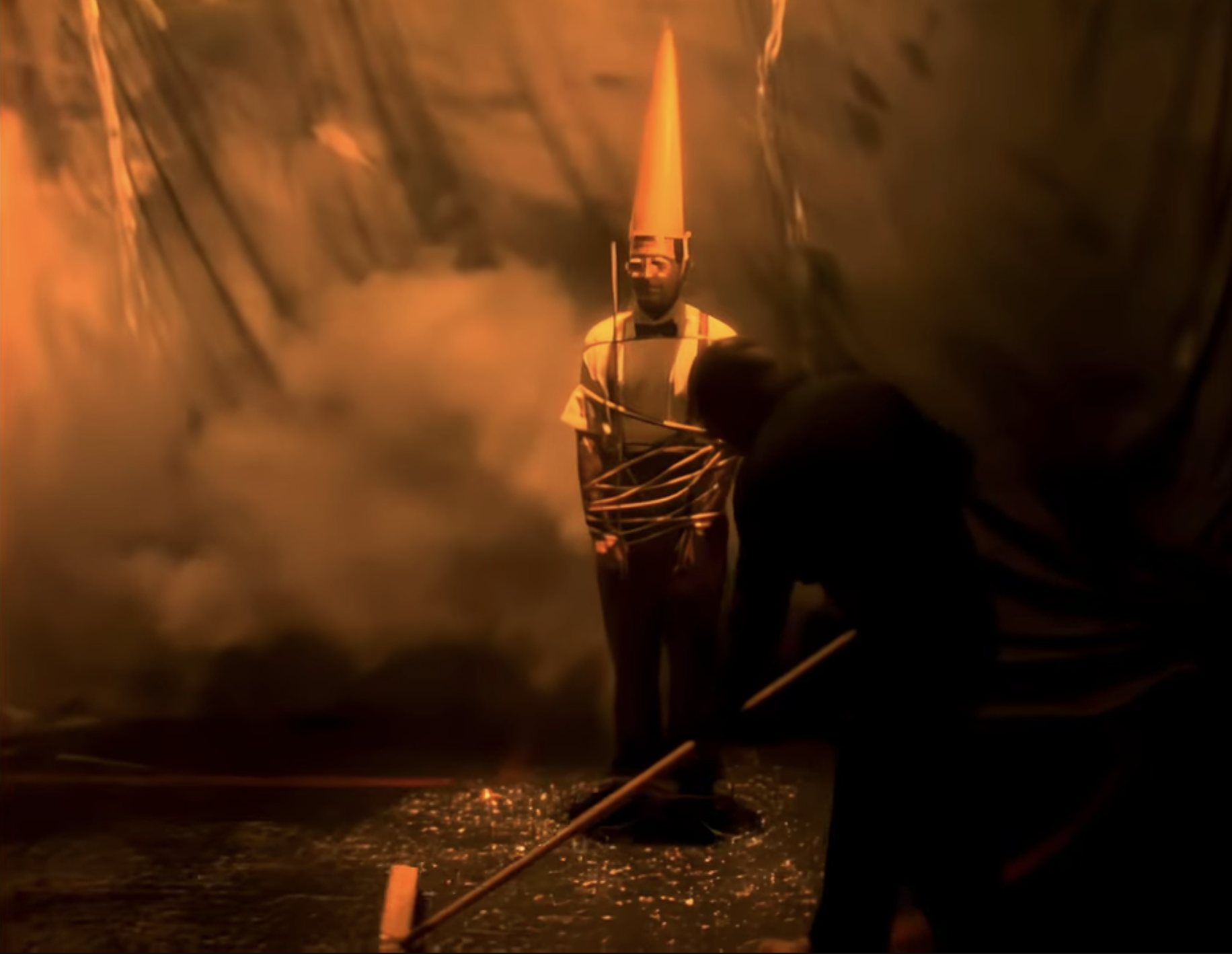
Anarchy isn't a system to replace government, its human behavior existing currently. We could see it easily with coercion removed but also we can see it in spite of. Mutual aid and spontaneous order happen all around us all the time. It's not something that needs to be built, it's a reality that needs to be remembered. The remembrance will come easier when we're not cheering on command for a team we’re forced to support in a game that's being played later that we don't even want to play. Meanwhile the metaphorical team getting pepped for in “Smells Like Teen Spirit” isn’t a team playing a game later on—the game is happening right now. The game of us moving freely as individuals, together, in harmony.
Nirvana, if you will.
Thanks for entertaining us.
H o m e w o r k
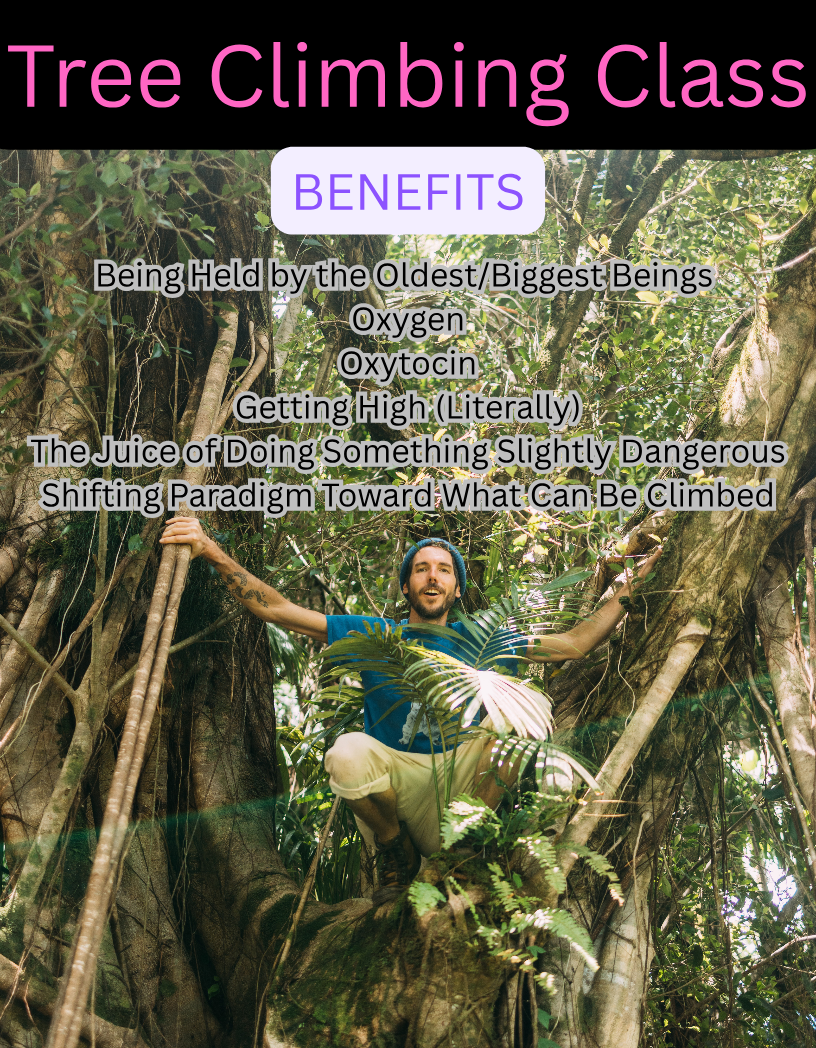
Make a list of one (or more) classes that you'd like to see being taught in hypothetical anarchy school, or in any school for that matter.
Then write one (or more) benefits you foresee that class have in its students lives and/or existence in general.
Extra Credit:
Send that list to your Professor Gray Balls, this guy below providing you with a class and benefit example.

Member discussion: